
Engineering leadership judgment
Understand the organizational reality behind the metrics, including ownership, priorities and practical constraints.
Our Approach · Continuous Tech Improvement
Expert judgment backed by engineering evidence.
Continuous Tech Improvement is a discipline for making technology organizations more effective over time. Axelerant starts with Engineering Delivery Flow, using experience, structured analysis and the GamePlan method to guide changes that teams can actually sustain.
EVIDENCE
Available engineering data, workflow context and competing hypotheses.
DECISION
One bounded intervention with ownership, risks and success criteria.
CHANGE
Guided adoption, outcome review and the next constraint.
The starting point
Collecting more data does not automatically improve delivery. And faster coding does not automatically mean faster, safer software releases.
Understand the organizational reality behind the metrics, including ownership, priorities and practical constraints.
Review workflow data and qualitative input together, making assumptions and uncertainty explicit.
Use repeatable frameworks, scorecards and suitable software to structure analysis, decisions and follow-through. Tools support experts rather than replace them.
The operating discipline
Understand the delivery flow, its objectives and available evidence.
Find candidate constraints; test explanations before investing.
Choose one improvement using impact, risk, feasibility and ownership.
Design and guide the intervention with the people doing the work.
Review what changed, what is uncertain and what matters next.
The process is iterative, not a claim that every problem has an automated or one-click solution.
Developer & Agent Experience
Better developer workflows and agent-ready infrastructure are complementary, not interchangeable.
Developers need clarity, autonomy and quick feedback. Agents additionally require explicit context, callable tools, constrained permissions, testability and traceability. The practical goal is a shared delivery system that enables quality work without sacrificing security or human ownership.
This provides a foundation for AI-native software delivery and, over time, more sophisticated AI Software Factory operating models. Those are directions for improvement, not turnkey products included in Axelerant’s advisory fee.
Onboarding, environment, CI feedback, deployment and self-service
Context, tool contracts, permissions, validation and observability
Reliable software changes with explicit human accountability
Focused entry. Wider perspective.
Our initial specialization is Engineering Delivery Flow. But the factor preventing improvement can live in a platform, requirements, team ownership or business priorities.
That is why DevEx, Platform Engineering, AI-enabled SDLC and organizational leadership belong to the diagnostic lens—even when the engagement is focused on one change.
Lead time, CI feedback, code review, delivery variability and reliability
Local environments, developer workflows, machine-readable context, safe tools and adoption
Human/agent collaboration, quality, review capacity and governance
The GamePlan method
GamePlan is the proprietary method underlying our advisory. It links the diagnosis, priority, ownership and verification of a technology improvement.
The wider GamePlan perspective helps distinguish a delivery symptom from the organizational or strategic decision causing it. It is not an additional package the client must buy.
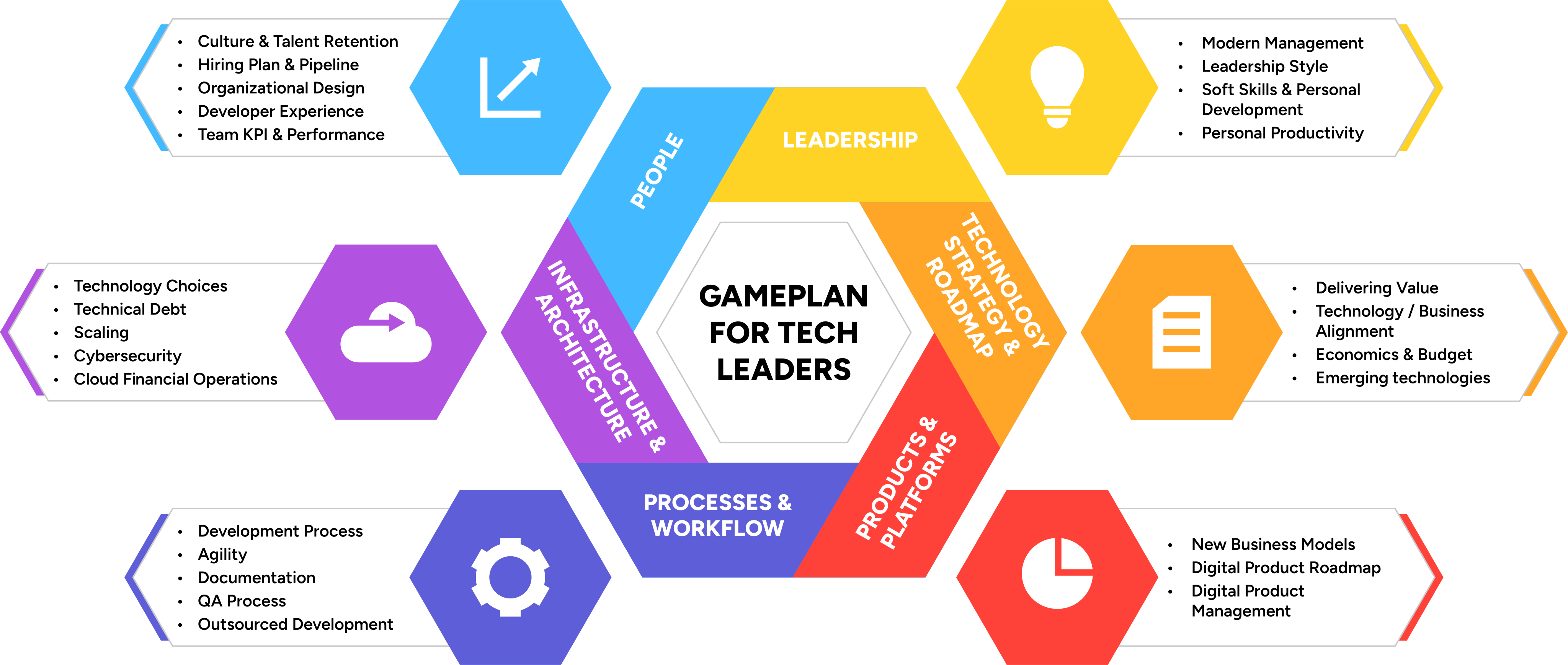
GamePlan map: a reference for context and decision-making, not a complete promise to cover every business function within one engagement.
Data and trust
We focus on end-to-end flow, constraints, handoffs, feedback quality and outcomes. We do not market individual developer productivity rankings or employee monitoring.
Evidence sources, permissions and data handling are agreed before the engagement. Read-only access is preferred where possible. Proprietary analysis capabilities are used only when available and appropriate.
The methodology does not guarantee a specific improvement percentage. The validity of outcomes depends on measurement quality, adoption and factors outside the engagement.
Put the method to work
See how an evidence-led, hands-on improvement program could work in your organization.