
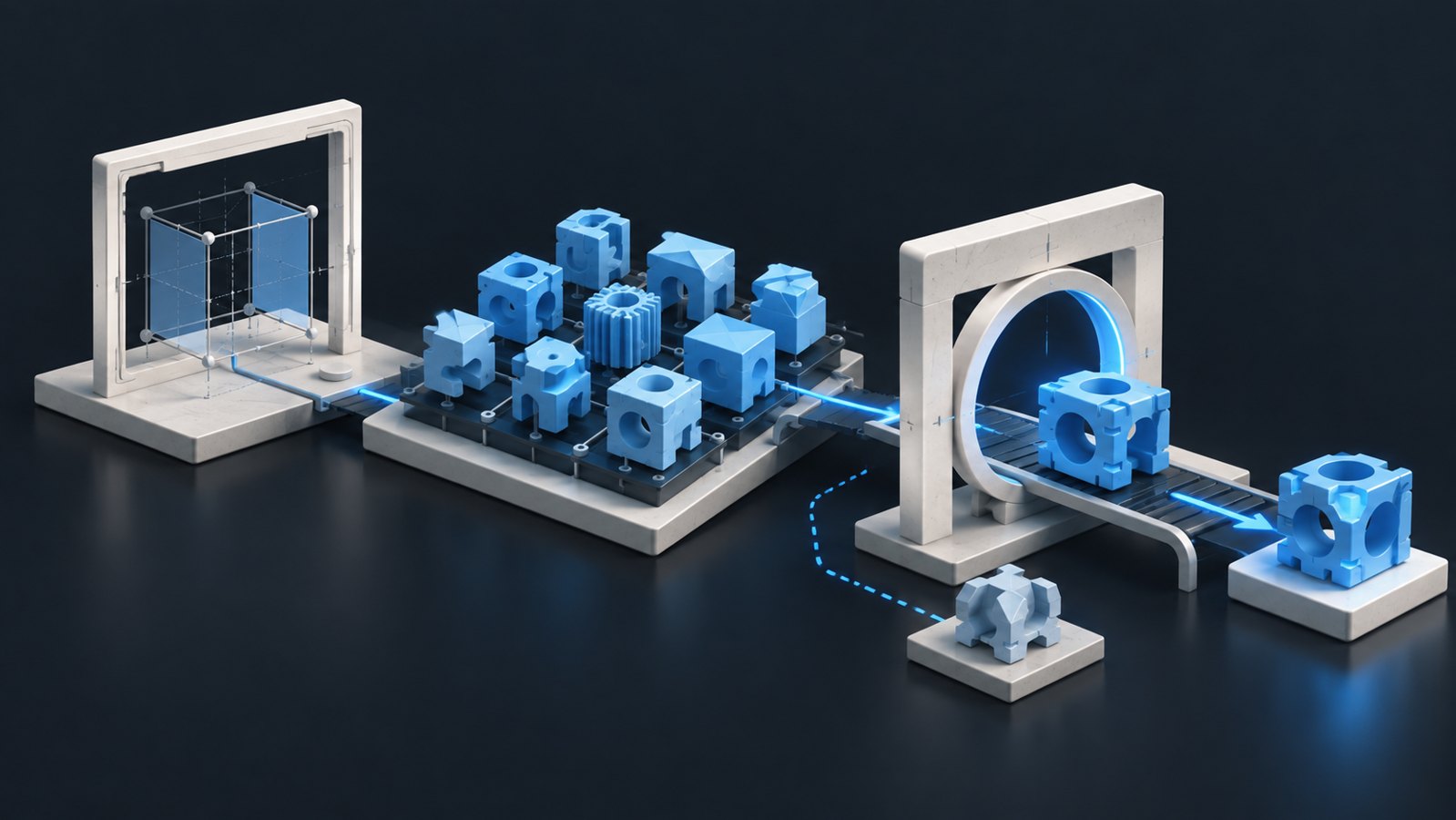
Your engineers have AI tools. Drafts appear faster. There are more experiments, generated tests and pull requests. Yet the customer is still waiting for the same release. What should you examine before buying more tools or expanding agent access?
Faster code generation changes one activity. The overall result also depends on whether someone can understand, review, validate, integrate and safely operate that code. Those activities need to be part of the AI adoption decision.
Choose the workflow before the tool
Start with a recurring piece of engineering work and its current difficulty. A useful candidate has a recognizable input, an expected output, an accountable owner and a way to judge whether the output is acceptable.
Possible candidates include preparing a change from an approved specification, drafting tests for an existing behavior, updating documentation after a change or investigating a failed build. These are examples to assess, not a promise that every workflow is suitable for automation.
Define where the workflow ends. For a coding task, a generated patch is an intermediate output. An accepted, validated change is a more useful endpoint for evaluating whether the workflow helps the team.
Find out where the work moves
Consider an illustrative pilot in which a tool produces implementation drafts sooner. If reviewers then spend longer checking unfamiliar changes and correcting assumptions, the saved drafting time may not translate into earlier completion.
Measure the full path on comparable work. Record preparation, generation, human review, validation, correction and waiting. Track failures and abandoned attempts alongside accepted results. Do not treat the number of generated changes or tool usage as proof of improvement.
Work varies, so a small sample is a starting point for judgment. Record task difficulty and changes in the team or process that could explain the result. Avoid presenting an early pilot as a company-wide productivity benchmark.
Make responsibility explicit in agentic workflows
An agent that can take several steps needs more than an instruction to complete a task. Specify what it may read or change, which actions require approval, how its work is checked and who owns the outcome.
- Context: the approved requirements, relevant code and constraints it should use.
- Access: the minimum permissions needed for the selected workflow.
- Evaluation: observable conditions for accepting or rejecting the result.
- Human intervention: who reviews, stops or corrects the work.
- Recovery: how changes can be identified and reversed where appropriate.
Include data handling and confidentiality requirements in that assessment. Verify the actual tool configuration rather than assuming that every assistant or agent has the same behavior.
Treat developer and agent experience as operating conditions
Unclear build instructions, unreliable tests and missing ownership make work harder for humans and agents. Before adding another automation layer, examine whether the selected workflow has usable documentation, dependable feedback and a clear route to completion.
AI SDLC and AI Software Factory can describe ambitions spanning planning, implementation, verification and operations. Those labels do not establish that the organization has a reliable operating model. Define the specific capability and its acceptance conditions before committing to a broader transformation.
Decide whether to expand, adapt or stop
Run a bounded pilot with an owner, a baseline and a review date. Compare completion time and human effort alongside quality, rework and operational consequences. Set the conditions for expansion before the results arrive.
A useful GamePlan may prioritize better context or evaluation before further automation. It may also conclude that a candidate is not worth pursuing. Both outcomes can prevent an organization from scaling a workflow it cannot yet supervise or measure.
Explore AI Enablement for Engineering, or discuss the engineering workflow you want to improve.
